


Protecting the Ōrewa Coastline
A new seawall and walkway improves resilience, public access, and supports lower-carbon construction
Along the coastline at Ōrewa, north of Auckland, a new seawall and shared walkway designed to protect one of the region’s largest beachfront residential areas from erosion while improving public access along the coast is taking shape. With its long sandy beach and popular walking and cycling routes, Ōrewa is a well-loved coastal destination, making the protection and improvement of this foreshore especially important for the community.
Behind the basalt stonework and coastal protection engineering is another important element shaping the project: the use of Holcim ECOPlanet low-carbon cement, supporting the project’s performance and durability requirements while helping to reduce its embodied carbon.
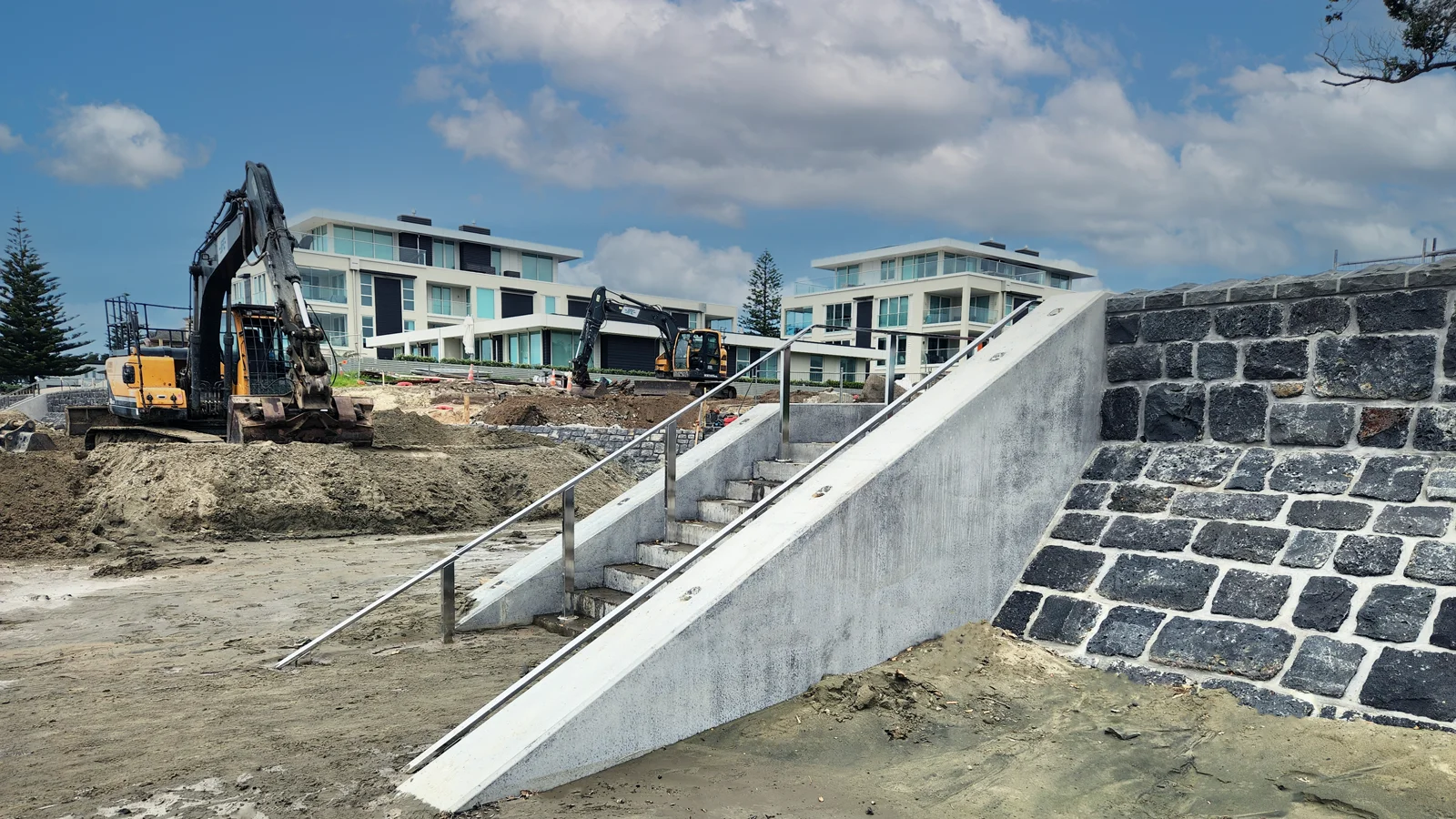
The Ōrewa seawall and shared walkway is helping protect the coastline from erosion while improving access for the local community and visitors.
Coastal resilience, local materials
The project includes construction of a 600-metre seawall and shared path, planting along adjacent reserves, in-ground lighting, and improved beach access via three ramps and five sets of stairs. Beginning in late 2024, and with a total project cost of more than $21 million, the new seawall and walkway is now nearing completion.
The project’s main contractor, JFC Ltd, appointed Vea Contractors as one of two stonemasonry contractors for the seawall works. Since mid-2025, Vea’s crew of 18 stonemasons has been on site hand-shaping and placing locally sourced Auckland basalt to form the seawall. The blocks are placed and aligned before being grouted in place using Holcim’s ECOPlanet cement, forming the seawall structure designed to perform in a coastal marine environment.

Hand-shaped Auckland basalt and Holcim ECOPlanet low-carbon cement are helping deliver a durable, lower-carbon seawall for the Ōrewa foreshore.
Lower-Carbon Cement for Marine Durability
All grout for the seawall was mixed onsite using a large mixer. During the later stages of the project, Holcim’s ECOPlanet low-carbon cement containing 60% General Purpose cement and 40% slag was used for the mortar.
The use of ECOPlanet cement supplied in 20kg bags helped reduce embodied carbon while providing the durability required for long-term performance in a marine environment, where resistance to chloride ingress and corrosion is critical.
Supporting More Sustainable Infrastructure
By combining locally sourced basalt with lower-carbon cement, the Ōrewa seawall and walkway project demonstrates how coastal infrastructure can be built for long service life while also reducing environmental impact.
As infrastructure projects increasingly consider embodied carbon alongside durability and performance requirements, ECOPlanet low-carbon cement is becoming an important part of delivering more sustainable construction across New Zealand.
Banner image: Ōrewa Beach courtesy Isla Gilroy on Unsplash.